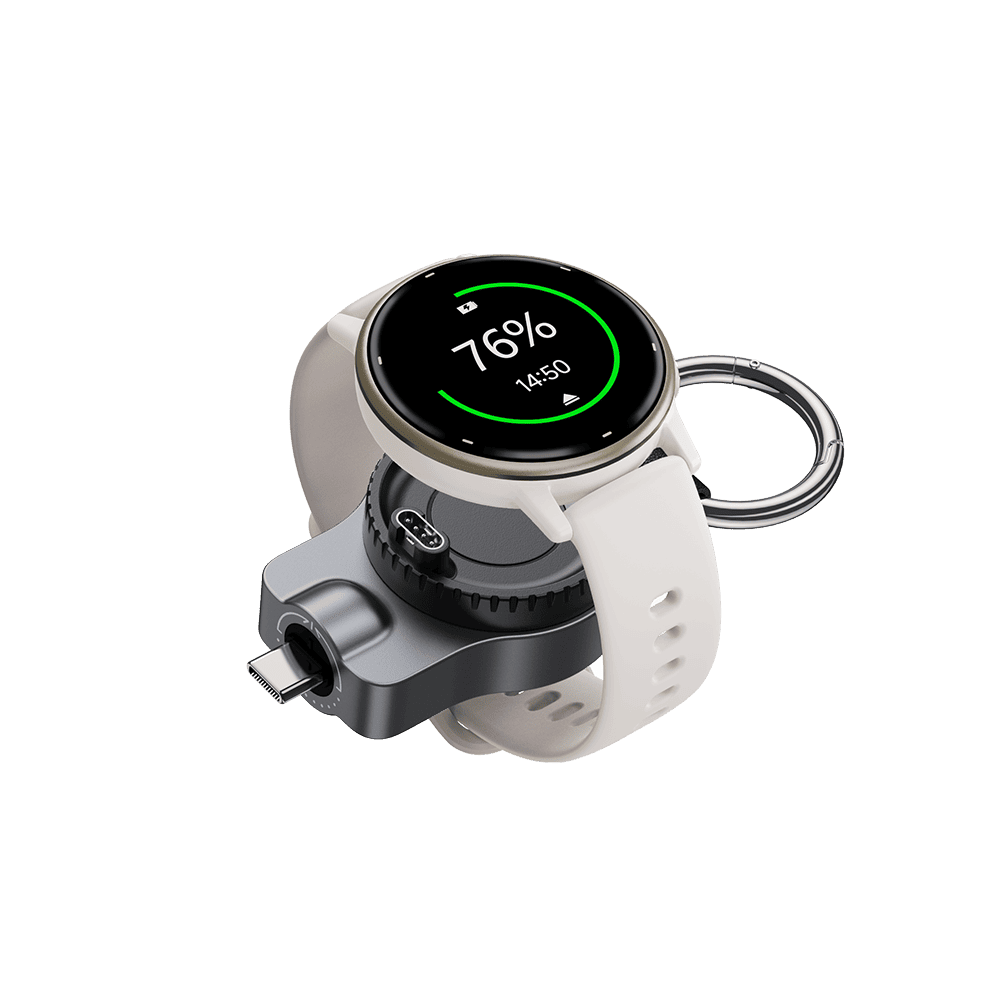


You set your Garmin on the same wireless charging pad that works perfectly for your phone. Nothing happens. You try the Apple Watch charger sitting on your desk. Still nothing.
It looks like a defect, but it isn't. Garmin and Apple built their watches to charge in two fundamentally different ways, and that difference explains why a generic wireless pad can't power a Garmin. This guide breaks down how each system works, why Garmin sticks with metal contacts, and what that means for the charger you buy.
The short answer
Most Garmin watches charge through a small set of metal pins that must physically touch matching contacts on the back or side of the watch. Apple Watch charges wirelessly, using a magnetic charger that transfers power through a coil. A standard wireless pad has the coil but no pins, and the Garmin has the pins but no coil, so the two never connect.
How Apple Watch charges
An Apple Watch has a charging coil built into its back. The charger is a small magnetic puck that has its own coil. When you set the watch on the puck, magnets pull the two coils into alignment and power passes between them through a magnetic field, with no metal-to-metal contact.
That is why Apple Watch charging feels forgiving: the magnets snap the watch into the right spot, and you don't need to line anything up by hand.
It is also worth knowing that Apple's charger is its own system. It is not the same as the standard Qi pads used for many phones and earbuds, so even Apple Watch can't be charged on just any wireless pad.
How Garmin charges
Most Garmin watches have a small group of metal contacts, usually on the back or the side of the case. The charger has matching spring-loaded pins. When the two sets of contacts touch, power flows directly through the metal, the way it does through a USB cable.

There is no coil involved and no magnetic field to carry the power. The connection works only if the pins and contacts are touching cleanly, which is why alignment and clean contacts matter so much with Garmin chargers.
Side by side

| Garmin (pin contact) | Apple Watch (magnetic wireless) | |
|---|---|---|
| How power transfers | Directly through metal contacts | Through a magnetic field between two coils |
| What's on the watch | Small metal charging contacts | A charging coil |
| Alignment | You line up the pins | Magnets snap it into place |
| Works on a standard Qi pad | No | No, it needs Apple's own charger |
| Typical weak point | Dirty or corroded contacts, misalignment | Coil alignment and heat when charging wirelessly |
Why Garmin uses contacts
Garmin hasn't published a full explanation, but the trade-offs of the two approaches help explain why many sport and outdoor watches use contacts:
- Efficiency. Charging through direct contact generally wastes less energy as heat than inductive charging, where some power is lost between the coils.
- Space. A watch with a charging coil needs room for that coil and its shielding. Without one, more of the case can be used for the battery and sensors.
- Rugged, sealed designs. Metal cases, tough materials and sealed, water-resistant builds are common on outdoor and multisport watches, and they can make coil-based charging harder to engineer.
- Predictable behavior. A wired contact either connects or it doesn't, with no dependence on a magnetic field being aligned just right.
None of this makes one approach better in every way. It is a set of trade-offs, and Garmin has chosen the one that suits its watches.
Why a generic wireless pad can't charge a Garmin
A standard wireless charging pad works by creating a magnetic field that a coil in your device picks up. A Garmin has no such coil to pick it up. There is simply nothing in the watch listening for that signal, so placing it on a pad doesn't do anything. It won't harm the watch, but it won't charge it either.
The reverse is also true. A Garmin charger has pins but no coil, so it can't charge an Apple Watch or a phone on its own. The two systems use different physical connections, so they are not interchangeable.
This is also why Garmin charging accessories are less common than ones for phones. A charger has to be made specifically for Garmin's pin layout, and it needs to be built and tested around the pin spacing and the way the contacts sit on each watch.
The downsides of contact charging
Contact charging is reliable, but it has two weak points:
- Alignment. The pins have to touch the contacts. Even a small misalignment, or a case or film covering the contacts, can stop charging.
- Dirt and corrosion. Sweat, skin oils and moisture build up on exposed contacts over time. A thin film or corrosion on the pins is one of the most common reasons a Garmin stops charging.
If your Garmin is already giving you trouble, our step-by-step guide can help: Garmin Watch Not Charging? 7 Fixes That Actually Work.
Charging a Garmin and a phone together
Because Garmin charges through pins and phones charge wirelessly, the two can share one station as long as the station has both. SwanScout's 3-in-1 stations pair a pin-contact connector for the Garmin with wireless charging for your phone and earbuds:
- 712GM and C02GM use magnetic charging for MagSafe-compatible iPhones.
- C01GM uses standard Qi wireless charging, so it works with iPhones and Android phones.
We compare the three in detail here: Can't Find a Garmin Watch Charger? This One Also Charges Your iPhone.
FAQ
Can I charge my Garmin on a Qi wireless pad?
No. A Garmin watch has no wireless receiver, so a Qi pad has nothing to connect to. It needs a charger built for Garmin's pin contacts.
Can I use an Apple Watch charger for my Garmin?
No. An Apple Watch charger is a magnetic wireless puck. It has no pins, and a Garmin has no coil, so they can't charge each other's devices.
Are all Garmin chargers interchangeable?
Not always. Garmin has used different connector designs across its watch lines, so check the compatibility list for your specific model before you buy.
Is contact charging less safe than wireless charging?
No. Charging through metal contacts is a standard, well-established method. A good charger adds protections such as over-voltage, over-current, over-temperature and foreign object protection.
Does it matter that Garmin charging is slower than my phone?
Garmin watches have small batteries and charge at low power. SwanScout's Garmin chargers deliver up to 3W, which is what the watch is built to accept.
Find the right Garmin charger
Browse the full SwanScout Garmin charger collection to find a pin-contact charger for your model, from a keychain-size travel option to a 3-in-1 station for your desk or nightstand.